




It’s a scene we all know: an artist clutching a new Oscar, the orchestra music already beginning to swell, and a frantic race against the clock to thank the most important people. On that stage, time is a non-renewable resource, and every word is a strategic choice.
That’s what made a specific moment in Billie Eilish’s acceptance speech so striking. With the world watching, she used her precious seconds to give a direct and heartfelt thank you to her childhood choir teacher, Mandy Bigham, and the Los Angeles Children's Chorus (LACC) by name.
In a moment defined by monumental achievement, why was this specific acknowledgment so critical that it made the cut? That shout-out was more than a gesture of gratitude; it was an accidental masterclass in the architecture of elite talent. It reveals a universal blueprint for success built on the twin pillars of disciplined technique and earned confidence—the often-invisible engine that drives every great leap of innovation.
Technique Isn't Just Skill—It's the Framework for Freedom.
The training Eilish received at the LACC provided a deep "technique" that goes far beyond simply hitting the right notes. This is about mastering the "architecture of sound"—the mechanics of breathing, the nuances of dynamics, the ability to blend with other voices, and the skill of sight-reading under pressure. This is the disciplined, repetitive work that builds intellectual muscle memory.
This concept extends far beyond the arts. The pattern recognition required for sight-reading in a high-stakes concert environment is functionally similar to the skills a software developer uses to debug thousands of lines of code on a tight deadline, or a financial analyst needs to scan a complex statement for critical information. It’s the ability to process complex inputs, see the underlying structure, and execute a response without freezing.
Herein lies the central paradox of mastery: the most rigorous discipline becomes the very source of the greatest creative freedom. Eilish’s unique, minimalist "whisper" style isn't a limitation born from a lack of power; it's a deliberate artistic choice. It's an innovation made possible only because her foundational technique gave her the absolute control and knowledge to break the rules effectively.
"Her unique style is an innovation that's built on a foundation of knowing exactly what her instrument can do. The technique gives her the control to be understated."
Confidence Is Earned, Not Assumed.
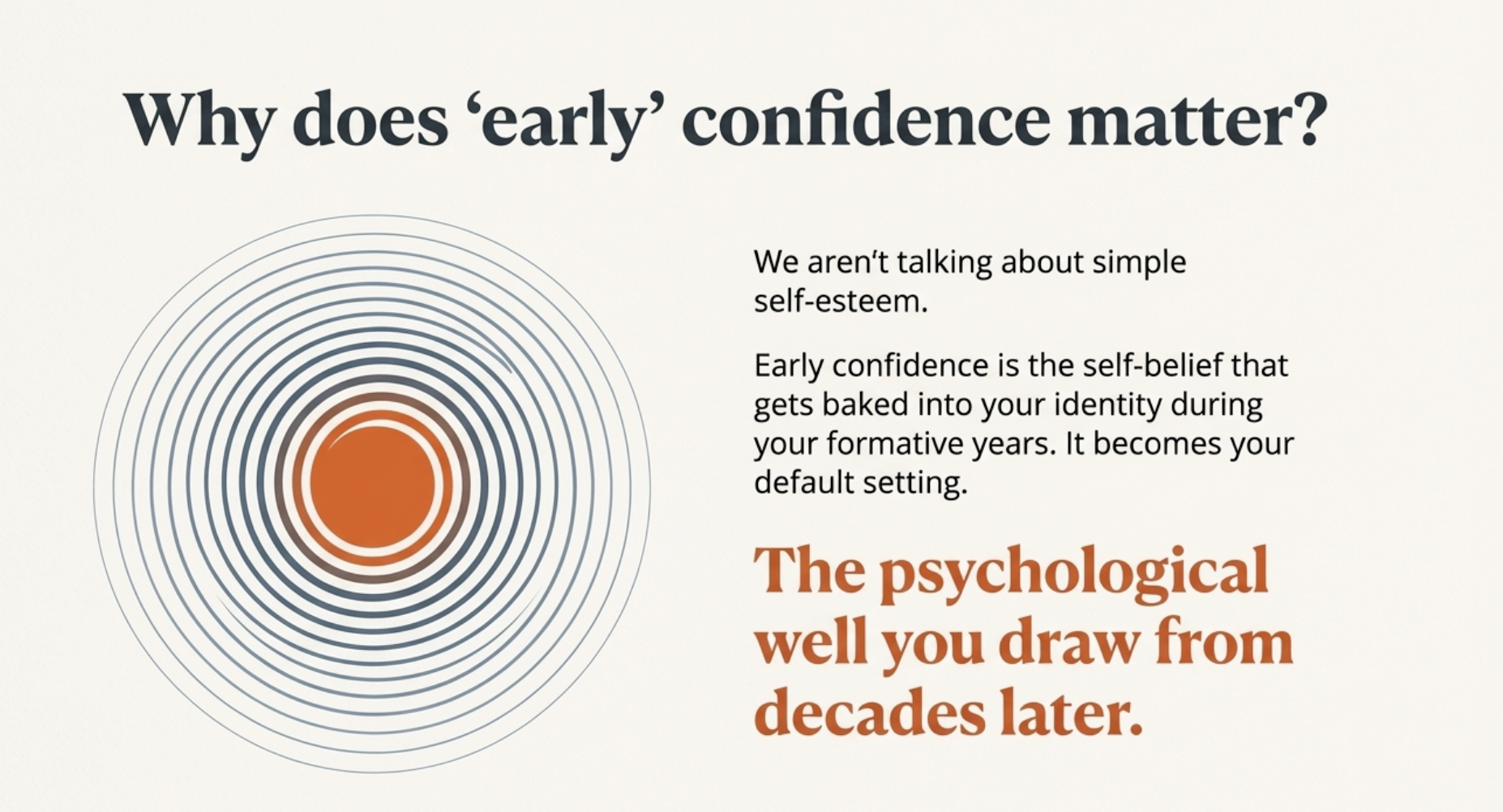
The source of Eilish’s success points specifically to the power of early confidence. This isn't just self-esteem; it's a fundamental self-belief that gets "baked in" during our formative years, becoming a default setting that we draw upon for decades.
Crucially, this confidence is not the result of empty praise. Structured environments like the LACC act as "safe crucibles for failure." They demand excellence, meaning students will inevitably make mistakes. They will miss notes. But under the guidance of expert mentors, they learn the critical skills of how to recover, learn from the error, and perform again.
This stands in stark contrast to the "brittle confidence" or "false bravado" that comes from praise disconnected from actual achievement. Confidence born from proven technical skill is robust and resilient. It is built on concrete, undeniable data points of your own capability.
"Robust confidence is the difference between thinking, 'I think I can handle this,' and knowing, 'I know I can handle this,' because you have the undeniable proof of your own capability."
Technique and Confidence Feed Each Other.
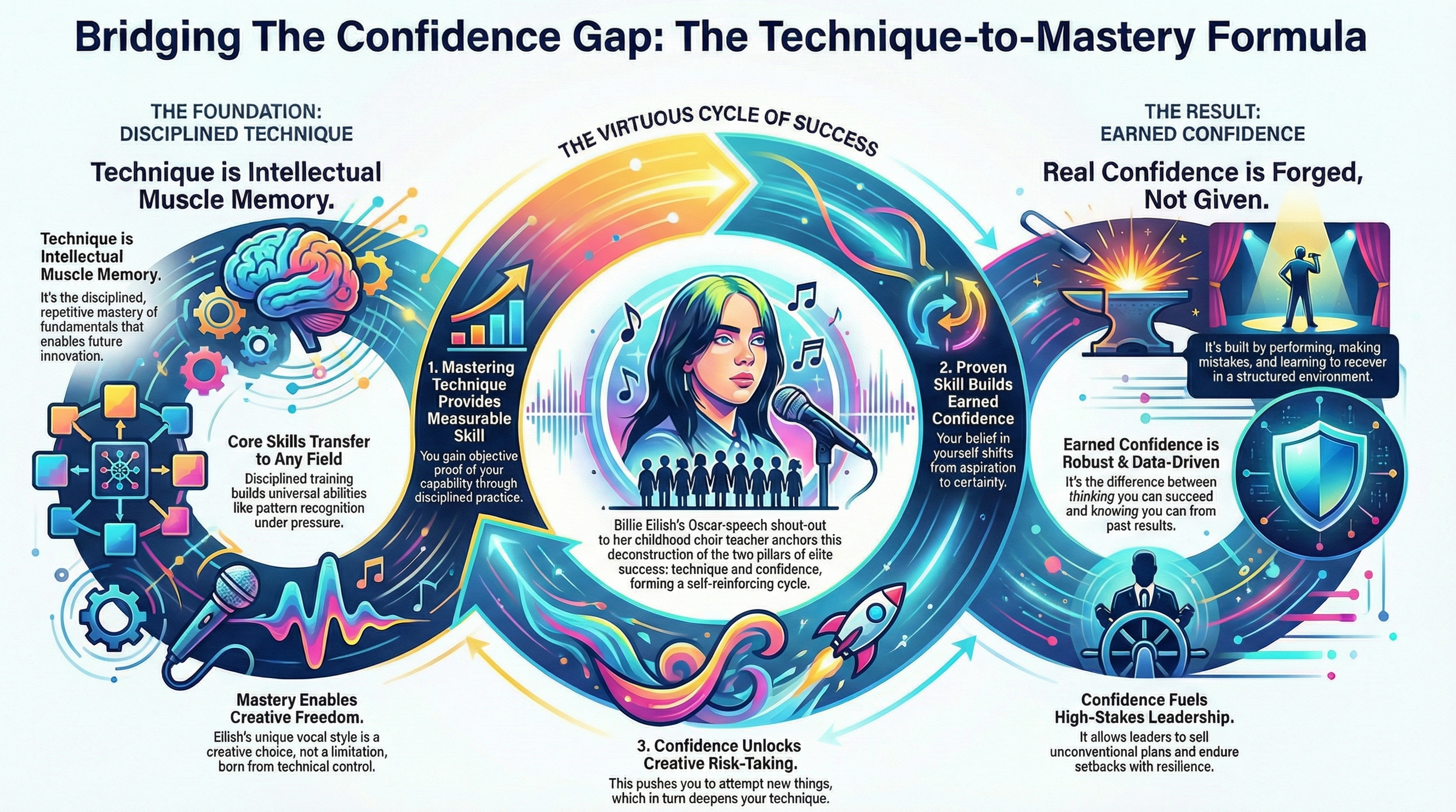
The core insight is that technique and confidence are not separate pillars but are "mutually reinforcing" components of a self-sustaining loop. They create an upward spiral of mastery.
The cycle works like this: Mastering a difficult technique provides measurable, objective proof of your skill. This evidence of competence builds justified, earned confidence. That powerful, earned confidence then empowers you to take bigger creative and professional risks—to try something unconventional. Taking those risks, in turn, pushes you to develop and refine your technique even further to meet the new challenge.
This dynamic applies in any high-stakes field. Consider a business leader navigating a corporate crisis. They need the technical expertise in finance or production to create a viable turnaround plan. However, it is their earned confidence—built from years of successfully executing smaller plans—that allows them to sell that difficult vision to a skeptical board, withstand setbacks, and absorb the immense pressure without faltering.
Billie Eilish’s Oscar thank-you was more than a tribute; it was a lesson. The roots of her high-profile, innovative success are found in early, disciplined training that forged both the technical skill to perform and the resilient confidence to create.
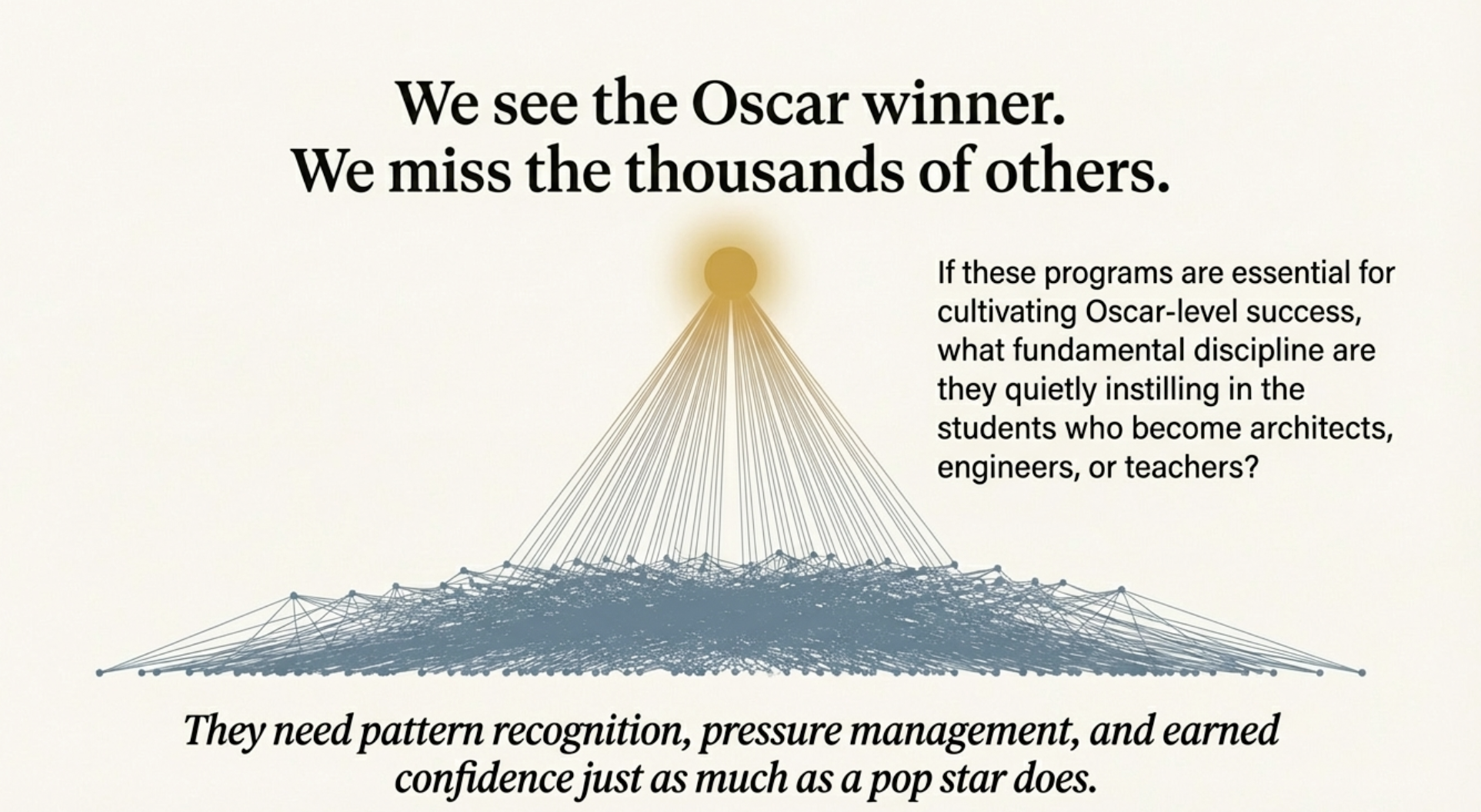
But the lesson extends far beyond the "one in a million" superstar. While we celebrate the visible outcome of an Oscar winner, we must consider the thousands of other students who pass through these same foundational programs. They are building the same skills—pressure management, pattern recognition, and recovery from failure—that are just as essential for their futures, and this reality forces us to ask a much larger and more critical question.
Final Thought
If this foundational training is essential for a superstar, what is the true cost when we undervalue or remove the very programs that build this same discipline and durable confidence in the future architects, engineers, and leaders our society depends on?
-1.png?width=500&name=Blog%202%20image%20(Motivation)-1.png)